Showing posts with label 13C. Show all posts

Thursday, 17 November 2011

Hell-mouths!

I love a good hell-mouth picture, so thought I'd post a few up here:

From a late 14C Book of Hours. This scene shows the Last Judgement. On the left border, souls climb a ladder up towards Heaven. At the bottom the dead awaken from their graves and move either towards paradise, or the gaping jaws of Hell.


 Part of a cycle of wall paintings at the church of Saint Mary in Pickering, North Yorkshire. They were completed in the late 15C, and restoration work was carried out in the 19C. This one shows Christ rescuing souls from the jaws of Hell.


 15C alabaster depicting the Harrowing of Hell. A small devil holding a key and blowing a horn is sitting on top of the hell-mouth, representing the doorkeeper of Hell.


 A page that illustrates the Office of the Dead from the Bedford Hours (15C). The centrepiece is an image of the Last Judgement. Christ welcomes worthy souls into Heaven, whilst the damned are beaten and dragged into Hell's mouth.


 Early 14C manuscript showing scenes of the life of Christ. The image at the top left depicts the Harrowing of Hell.


 An image from the Winchester Psalter (c.1225). The damned are being swallowed into a hell-mouth, with an angel to the left about to lock the jaws behind them. Inside Hell are lots of tortured souls, including kings and queens - nobody is above judgement.


 13C manuscript. this images shows the battle of the beast during the Last Judgement.


13C manuscript with this page depicting the fall of the angels. Christ sits above in his circle of Heaven surrounded by ranks of angels. In the lower part of the circle rebel angels can be seen falling downwards into the jaws of Hell, transforming into devils along the way.


Sources Used


Monday, 17 January 2011

The Crusades and Those Left Behind


I've been reading through a lot of medieval poems/songs recently as part of research for my dissertation. I came across one called Giammi Non Mi Conforto (Never Again that Comfort for Me). It is from the mid-thirteenth century, and was written by an Italian nobleman named Rinaldo d'Aquino. I found it interesting because although it was written by a man, it is from the perspective of a woman who has been left behind by her crusader lover. It is really quite insightful into what the people who were left behind went through; and actually rather sad. 


Never Again that Comfort for Me

Never again that comfort, 
Never that joyous heart.
The ships down in the harbor
Are straining to depart.
Away all the people run
To lands across the sea.
But me - poor weeping thing -
What shall become of me?

Away, away he'll run, 
Fade quietly out of sight, 
Leaving me here alone.
All day, all the night
Many will be the sighs
That assail me constantly
Not in heaven, nor on earth
Will life exist for me.

O holy, holy Savior 
Who from Mary came our way!
Watch, protect that lover, 
Since you're taking him away.
O reverenced and feared
Power from above!
In your hands I place
My tender love.

O cross that saves mankind, 
You plummet me to error,
Twisting my grievous mind
Beyond all hope of prayer.
Why, O pilgrim cross,
Why this bitter turn?
Bowed beneath my loss,
I kindle; O I burn.

The Emperor who rules the world
In his peaceful sway
Ravages poor little me
By taking my hope away.
O reverenced and feared
Power from above!
In your hands I place
My tender love.

When he took up the cross,
I didn't know the end was this:
Whatever love he gave me
I repaid him kiss for kiss.
Now I'm thrust aside -
Yes, condemned to prison -
Now I'm forced to hide
In lifelong derision.

The ships are in their moorings.
Soon they'll depart.
With them and that rabble
Sails my heart.
O Father, O Creator,
Guide them to holy haven, 
By your sacred cross
They're all enslaven.
And O darling, I beg you:

Take pity on my hysteria.
Write me a little sonnet.
Send it to me from Syria!
Night and day I'll know
Only this bitter strife.
In lands beyond the ocean
Lies my whole life.1


1  Translation from S.J. Allen and Emilie Amt (eds.), The Crusades: A Reader (Broadview Press: Peterborough, 2003), pp.215-17.


Monday, 15 November 2010

Pembroke Castle


Hi again! I went to visit Pembroke castle in September for my birthday, and thought I would share a few pictures of it here.


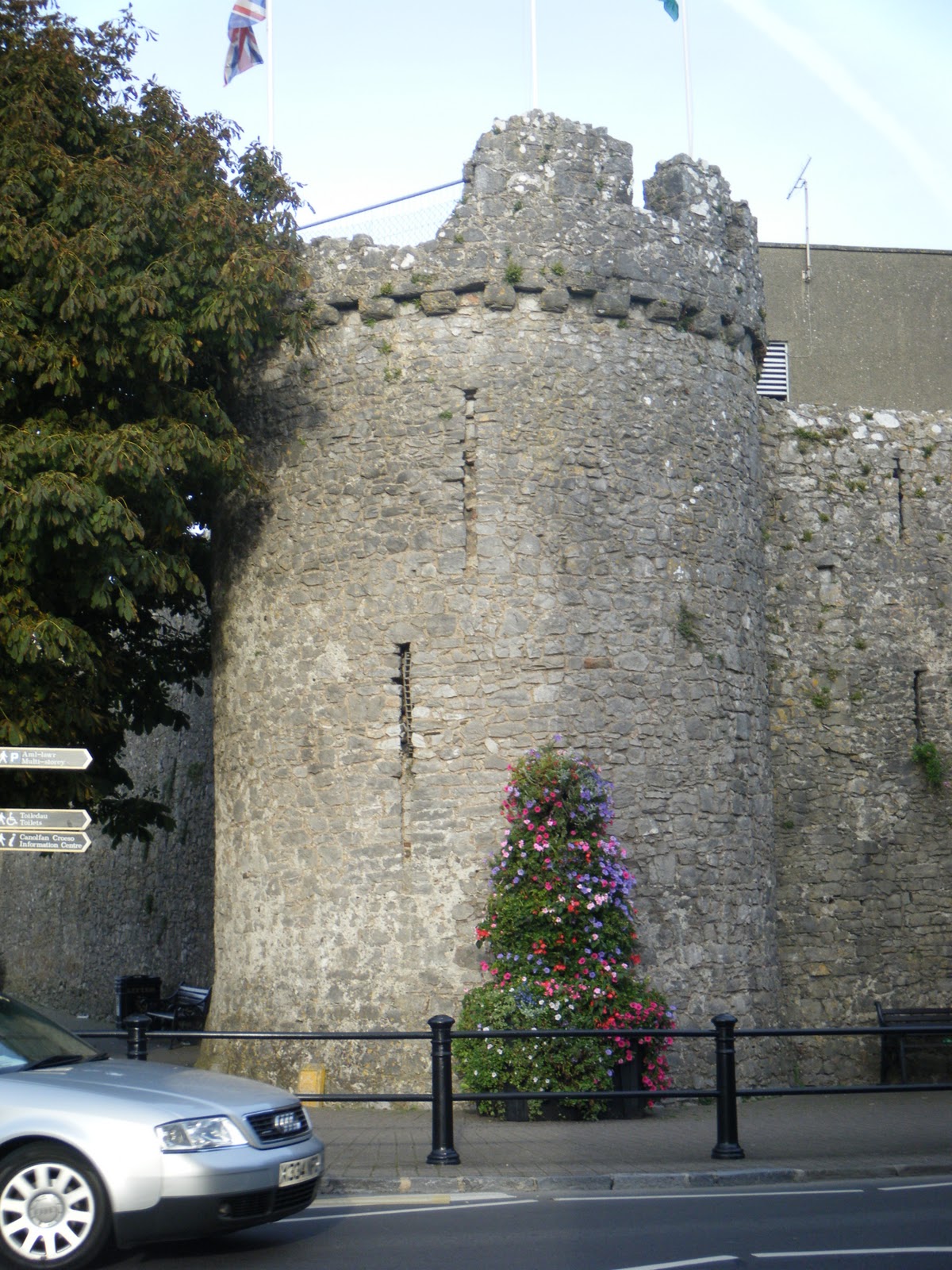
I stayed by the coast in Tenby, which is a gorgeous little town with fantastic surviving medieval walls that I think date to the 13C. The picture to the left shows a section of them.


Pembroke is a lovely little place, it is easy to imagine the castle being an overwhelming sight and dominant feature of the medieval town. As you walk up the main street the castle begins to come into view (as seen in the picture to the right). Arguably one of the greatest Earls of Pembroke was William Marshal (named Earl in 1199 by King John). His banner of a red lion against a yellow and green background was proudly displayed near the front entrance. I thought this was a particularly nice touch.

The original timber castle would have been built after the Norman conquest in the late 11th - early 12thC. However the site itself has a long history. Below  the castle is a cavern called The Wogan, which would have been a shelter for cave dwellers during the Stone Age. It can be accessed in the Great Hall. The original castle was constructed by Roger de Montgomery, a cousin of William the Conqueror. Later in 1138 the earldom of Pembroke was created for Gilbert Fitz Gilbert de Clare, a loyal supporter of King Stephen of England. Gilbert was given the nickname 'Strongbow'. He died in 1148 and the earldom passed on to his son Richard, also nicknamed Strongbow. Richard is probably most well known for conquering Ireland.


William Marshal gained the earldom through marriage to Richard Strongbow's daughter Isabel de Clare. It was from this time that major reconstruction work began on the castle in stone. Work began with this beautiful round keep. This is the largest and one of the earliest towers of this design in the country. The stone steps are a later Tudor addition. Originally the keep would have been entered on the first floor by a set of timber steps.


William's sons continued work on the castle after his death in 1219. The Inner Ward was rebuilt in stone. It is also likely the large outer ward was laid out at this time too, and would have replaced an area of the town. This was rebuilt in stone later on by the new lord of the castle William de Valence, a rather unpopular figure at the time. Gradually, bit by bit, Pembroke became the mighty castle that survives today. 


Here are some more pictures:


View of Pembroke River


Northgate Tower


Stairway and door leading to Barbican Tower


Where the chapel once was


Western Hall, added between 1219 and 1245. This could have been a retiring room for the ladies of the castle.


Arches in the Norman Hall or Old Hall. This section of the castle most likely dates to the time of Richard Strongbow (1150-70). However at a later date the old timber hall was remodelled in stone, which itself has been reworked a lot over time.


The Great Hall. This was added during the 13C and had two levels. The area on the ground floor would have been used as kitchens, and the first floor would have been the main hall. This can be seen in the architecture too - the arches on the first floor are far more grand than those on the ground floor.


Detail of one of the Early English Gothic style arches in the Great Hall.